portland trail blazers vs utah jazz match player stats: Stunning Stats You Missed
Introduction
If you watched the Portland Trail Blazers vs Utah Jazz game on March 14, 2026, you already know it was a wild one. The Blazers came out on top, 124 to 114, but the final score barely scratches the surface of what actually happened on that court. This was a game full of momentum swings, individual heroics, and some truly eye-opening performances from players on both sides.
In this article, I want to walk you through every major stat line from the Portland Trail Blazers vs Utah Jazz matchup. You will get the full picture, from the players who carried their teams to the numbers that explain why one team walked away with the win and the other went home wondering what went wrong. Whether you are a die-hard Blazers fan, a Jazz supporter, or just someone who loves digging into basketball stats, there is a lot here to unpack.
Let us get into it.
Final Score and Quarter Breakdown
Before diving into individual player stats, it helps to understand how this game unfolded quarter by quarter.
Portland trailed badly after the first quarter, with Utah leading 38 to 28. That is a 10-point deficit after just 12 minutes of play. Things looked shaky for the Blazers early. But then the second quarter happened, and Portland absolutely dominated. They outscored Utah 38 to 20 in the second, flipping the script entirely and taking a lead they never truly surrendered.
The third and fourth quarters were relatively even, with Utah narrowing the gap slightly but never enough to take back the lead. The final score of 124 to 114 tells a story of a comeback built in one explosive quarter.
Here is how the scoring broke down by period:
- Q1: Portland 28, Utah 38
- Q2: Portland 38, Utah 20
- Q3: Portland 29, Utah 31
- Q4: Portland 29, Utah 25
That second quarter is the entire story of this game. Portland’s biggest unanswered run was 20 straight points, which is the kind of burst that breaks a team’s spirit.
Portland Trail Blazers Team Stats Overview
Looking at the team numbers, Portland had a genuinely impressive night on offense. Here are the headline figures:
- Field goal percentage: 51.7% on 46 of 89 attempts
- Three-point shooting: 17 of 46 (37.0%)
- Free throw shooting: 15 of 16 (93.8%)
- Total rebounds: 52
- Assists: 34
- Steals: 16
- Blocks: 12
- Points in the paint: 56
- Bench points: 47
- Points off turnovers: 28
- Fast break points: 22
- Second chance points: 23
That free throw percentage of 93.8% is elite. When a team shoots that well from the line, it means they were both getting to the line and converting when it mattered. The 16 steals are also remarkable. Portland turned Utah over and punished them hard for it.
The 47 bench points were a key factor. When your starters are resting and the second unit keeps the lead intact or even extends it, that is a sign of a deep and well-coached roster.
Utah Jazz Team Stats Overview
Utah was not exactly bad. Their numbers were just a notch below Portland’s in every meaningful category.
- Field goal percentage: 45.7% on 42 of 92 attempts
- Three-point shooting: 13 of 30 (43.3%)
- Free throw shooting: 17 of 22 (77.3%)
- Total rebounds: 47
- Assists: 28
- Steals: 16
- Blocks: 3
- Points in the paint: 54
- Bench points: 28
- Points off turnovers: 38
Utah actually had the better three-point percentage on the night, 43.3% compared to Portland’s 37%. They also generated more points off turnovers, 38 to Portland’s 28. But they were significantly outrebounded, and their bench only contributed 28 points to Portland’s 47. That gap in bench production is often the silent killer in close games.
Portland Trail Blazers Player Stats Breakdown
Jrue Holiday: The Engine of the Win
Jrue Holiday was the best player on the floor in this game. His stat line reads like something out of a video game.
He finished with 25 points on 10 of 16 shooting. He knocked down 4 of 9 three-pointers and shot 62.5% from the field overall. He added 5 rebounds, 8 assists, 1 steal, and 1 block. His true shooting percentage was 74.1%, which is extraordinarily efficient.
What stands out even more is his plus-minus. Holiday was a plus 10 on the night, meaning Portland outscored Utah by 10 points while he was on the floor. His assist-to-turnover ratio was 2.67, showing he controlled the ball well even while orchestrating a high-volume offense.
If you want to understand why Portland won this game, Holiday is your first and most important answer.
Scoot Henderson: Explosive Off the Bench and Beyond
Scoot Henderson matched Holiday with 25 points and was arguably just as fun to watch. He shot 57.1% from the field, including a scorching 5 of 7 from three-point range, which works out to 71.4%. He also knocked down all 4 of his free throws.
Henderson grabbed 5 rebounds, dished 3 assists, and added a block. He had 5 turnovers, which is the one blemish on an otherwise outstanding performance. His true shooting percentage was 79.3%, making him one of the most efficient scorers in this game on either side.
His fast break numbers were also excellent. He scored 5 fast break points and converted 2 of 3 fast break attempts. He is the kind of player who makes you hold your breath every time he gets in open space.
Matisse Thybulle: Defensive Pest
Thybulle only scored 6 points, but his defensive impact was undeniable. He racked up 4 steals and a block in his minutes. That kind of defensive activity disrupts offensive flow in ways that do not always show up cleanly in the box score.
He shot 33.3% from the field and hit 2 of 6 threes, so offense is clearly not his calling card. But with 4 steals, Thybulle was the disruptive presence Portland needed to generate some of those 16 total steals on the night.
Vit Krejci: The Quiet Facilitator
Krejci’s 2 points do not tell his story. He pulled in 5 assists against just 2 turnovers. He grabbed 3 offensive rebounds, which led directly to second-chance opportunities. His plus-minus was plus 18, the highest on the team. When a player is on the floor and his team is winning by that margin during his time, that tells you he is doing a lot of things right.
Toumani Camara: Effort and Defense
Camara contributed 5 points, 4 rebounds, 3 assists, and 3 steals. He fouled out with 5 personal fouls, which limited his impact in the second half. But his defensive energy and his ability to create turnovers made him a net positive while he was on the court.
Jerami Grant: Mixed Night
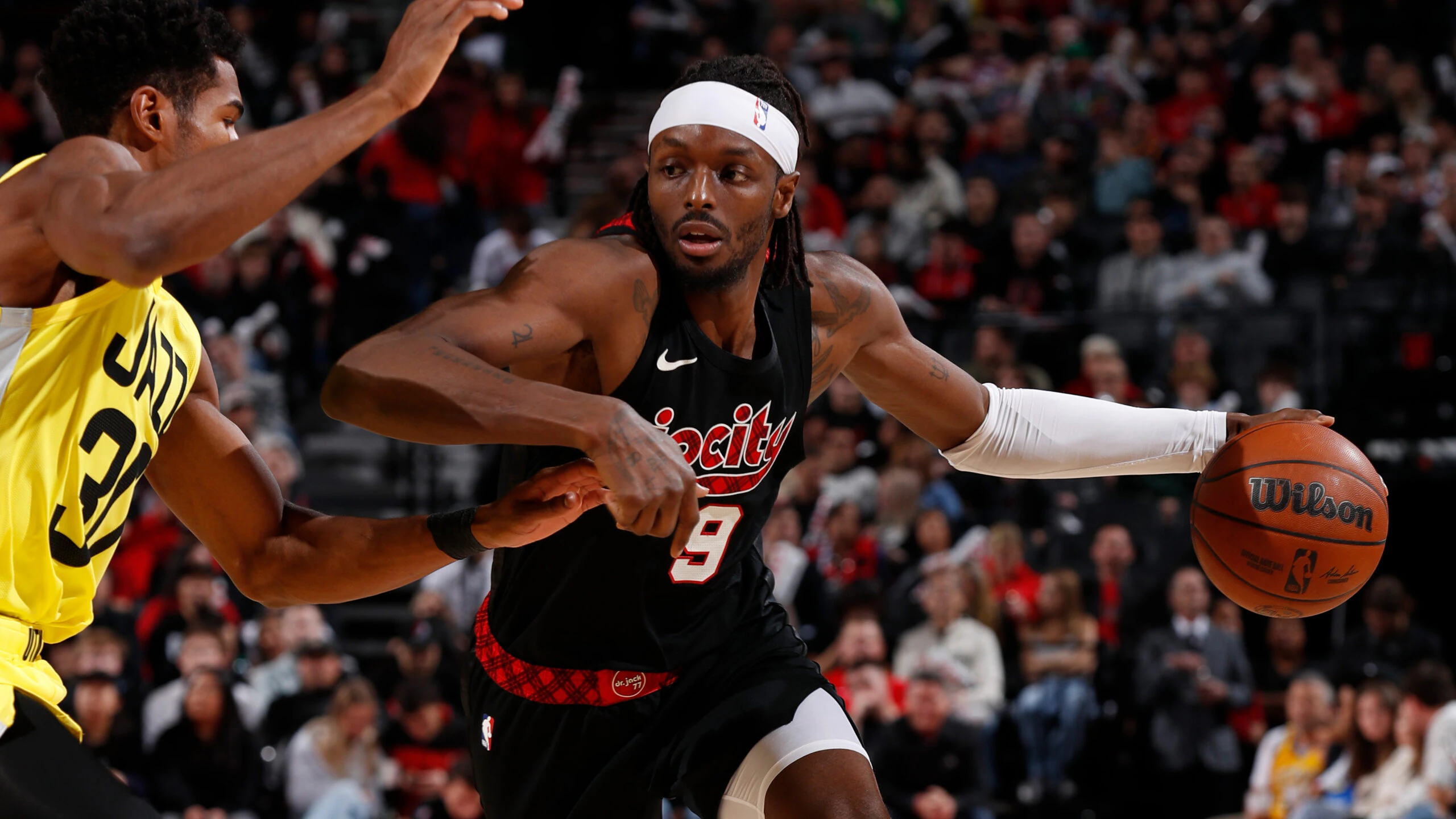
Grant finished with 9 points on 3 of 5 shooting, which is efficient on a low volume. He hit 2 of 4 threes and was perfect from the free throw line. The issue was his 4 turnovers, which dragged down his overall contribution. His plus-minus was minus 17, the worst on Portland’s roster. When Grant was on the floor, Utah was actually winning those minutes. It is a reminder that even in team wins, some individual stretches go badly.
Utah Jazz Player Stats Breakdown
Brice Sensabaugh: A Star Performance in a Losing Effort
If you were watching this game as a Jazz fan, Brice Sensabaugh gave you something to be genuinely excited about. He dropped 31 points on 12 of 19 shooting, including 6 of 8 from three-point range. That 75.0% from deep is not just good for one game, it is the kind of shooting that builds careers.
His true shooting percentage was 79.7%, and he generated 11 fast break points, converting 4 of 5 fast break attempts. He was relentless in transition.
Sensabaugh was Utah’s best player by a significant margin. He scored nearly twice as many points as the next-highest Jazz scorer. On a night when most of his teammates struggled to find consistency, he put together a performance you would frame and put on the wall.
Isaiah Collier: The Playmaker
Collier was Utah’s best facilitator on the night. He scored 17 points and dished out 9 assists against just 2 turnovers. His assist-to-turnover ratio of 4.5 is very good. He was effective driving to the basket, converting 6 of his 13 two-point attempts, and he got to the free throw line 6 times.
He was blocked 3 times trying to finish at the rim, which cost him some paint points, but his overall performance was one of the better two-way guard showings in this game.
Cody Williams: Active but Inconsistent
Williams put up 19 points on 7 of 17 shooting. He grabbed 7 rebounds and added 3 assists. He got to the line 7 times, converting 5 of them. On paper, 19 points, 7 rebounds, and 3 assists sounds like a solid outing.
But 4 turnovers and a plus-minus of minus 4 suggest that his moments of brilliance were accompanied by just enough mistakes to keep Utah from generating the sustained runs they needed. His fast break production was strong, scoring 9 points in transition, but that was not enough to overcome Portland’s second-quarter explosion.
Kyle Filipowski: Steady and Smart
Filipowski had a genuinely good game off the bench. He scored 11 points on 4 of 8 shooting and knocked down 3 of 5 threes. He pulled in 6 rebounds, handed out 5 assists, and notched 3 steals. His assist-to-turnover ratio was a perfect 5.0.
He was one of the few Jazz players who finished with a positive plus-minus at plus 12. His efficient play and decision-making gave Utah a reliable option, but he could not single-handedly keep pace with Portland’s output.
Elijah Harkless and Bez Mbeng: Struggles on the Wing
Both Harkless and Mbeng had difficult nights. Harkless finished with 10 points but shot just 25% from the field. Mbeng scored 4 points and was a minus 28 for the game, which is the kind of number that raises serious questions about fit and matchup.
Neither player was able to provide the secondary scoring punch that Utah needed alongside Sensabaugh. On a night when the margin came down to bench production, their quiet performances loomed large.
Key Storylines From the Game
Portland’s Second Quarter Was a Statement
A 38-to-20 second quarter is not just a good stretch of basketball. It is a complete dismantling. Portland shot well, defended aggressively, pushed the pace, and made Utah look disorganized. That quarter alone swung the game by 18 points and essentially decided the outcome.
The Steal Battle Was Fascinating
Both teams finished with 16 steals, which is an unusual tie in that category. But the way they generated those steals was different. Portland used their steals to create fast break opportunities. Utah generated points off turnovers at a higher raw number (38 to Portland’s 28), but they were still outscored overall because Portland’s offense was simply more efficient.
Portland Dominated the Glass
Portland’s 52 total rebounds to Utah’s 47 does not sound like a massive difference. But Portland grabbed 14 offensive rebounds, creating 23 second-chance points. Utah grabbed 10 offensive boards and converted them for just 10 second-chance points. Portland was more physical and more productive on the offensive glass.
Bench Depth Wins Games
Portland’s bench scored 47 points. Utah’s bench scored 28. That 19-point difference from reserve players is enormous. When your starters need rest, you need your bench to hold the fort or extend the advantage. Portland’s second unit did exactly that. Utah’s did not.
What This Game Means Going Forward
For Portland, this win was a demonstration of balance. They had two players each score 25 points. They had a facilitator in Krejci who quietly kept the offense humming. Their defense created chaos with 16 steals. And their bench gave them a genuine cushion.
For Utah, the Sensabaugh performance gives them a blueprint. If he can sustain that kind of efficiency, the Jazz have a genuine weapon. But they need more consistency from Collier and Williams, and they need their bench to contribute closer to 40 points rather than 28.
Conclusion
The Portland Trail Blazers vs Utah Jazz player stats from March 14, 2026 tell a story of two teams headed in different directions on that particular night. Portland came back from a first-quarter deficit with a historic second quarter, got big individual performances from Jrue Holiday and Scoot Henderson, and dominated with their bench depth. Utah had Brice Sensabaugh playing at a star level, but it was not enough to overcome the collective effort Portland put together.
If you enjoyed this breakdown, share it with a fellow basketball fan. And if you think there is a stat or a moment from this game I missed, I would genuinely love to hear your take. What surprised you most about this matchup?
Frequently Asked Questions
Q1: What was the final score of the Portland Trail Blazers vs Utah Jazz game on March 14, 2026? Portland Trail Blazers defeated the Utah Jazz 124 to 114. The game was played at Portland’s home court.
Q2: Who was the leading scorer for the Portland Trail Blazers? Both Jrue Holiday and Scoot Henderson led Portland with 25 points each. Holiday was slightly more efficient overall with a true shooting percentage of 74.1%.
Q3: Who was the leading scorer for the Utah Jazz? Brice Sensabaugh led Utah with 31 points. He shot 63.2% from the field and 75.0% from three-point range, making him the standout performer of the entire game.
Q4: How did Portland overcome a 10-point first-quarter deficit? Portland outscored Utah 38 to 20 in the second quarter. Their biggest unanswered run was 20 straight points, which swung the momentum completely.
Q5: What was Scoot Henderson’s shooting percentage in this game? Henderson shot 57.1% from the field and an impressive 71.4% from three-point range, connecting on 5 of 7 three-point attempts.
Q6: How many steals did Portland record in this game? Portland recorded 16 steals. Notably, both teams finished with the same total of 16 steals, but Portland converted those opportunities into more efficient offense.
Q7: How did Portland’s bench perform in this matchup? Portland’s bench contributed 47 points. Utah’s bench scored just 28 points. That 19-point difference from reserve players was one of the most decisive factors in the final result.
Q8: Was Kyle Filipowski effective for Utah in this game? Yes. Filipowski was one of Utah’s best performers, scoring 11 points with 6 rebounds, 5 assists, and 3 steals. His plus-minus of plus 12 was the best on the Jazz roster that night.
Q9: How did Jrue Holiday impact the game beyond scoring? Holiday finished with 8 assists and a plus-minus of plus 10. His true shooting percentage was 74.1%, and he managed the offense efficiently with a 2.67 assist-to-turnover ratio.
Q10: What were Portland’s points in the paint for this game? Portland scored 56 points in the paint compared to Utah’s 54. Both teams were aggressive attacking the basket, but Portland converted at a higher percentage once they got there.