The Cost of Ambition: How to Structure High-Stakes Academic and Funding Essays
The transition into higher education is a thrilling milestone, but it quickly introduces undergraduate students to an intense dual pressure. On one hand, you are expected to adapt instantly to a rigorous level of critical thinking and analytical writing. On the other hand, the soaring costs of tuition, textbooks, and living expenses mean that financial survival is constantly top of mind. For the modern student, academic success and financial stability are deeply intertwined, requiring a mastery of two entirely different forms of written communication.
Navigating this terrain requires more than just hard work; it demands a strategic understanding of how to present your ideas on paper. When balancing multiple dense modules, part-time jobs, and personal commitments, the sheer volume of written work can become paralyzing. For many undergraduates who are struggling to bridge the gap between high school composition and university-level analysis, seeking an external essay writing help service becomes a vital step in learning how to structure complex arguments without drowning in the workload.
Part 1: The Blueprint for Advanced Academic Essays
University essays are not merely longer versions of high school assignments. They require a shift from descriptive writing—simply stating what happened—to analytical synthesis. Your primary goal is to engage with existing research, challenge assumptions, and construct an objective argument based on empirical evidence.
The MEAL Paragraph Framework
To maintain absolute clarity across a 3,000-word research paper, your structural foundations must be flawless. A highly effective method used by top academic writers is the MEAL framework, which ensures that every single paragraph serves a distinct purpose:
- M (Main Idea):The topic sentence. This states the specific claim or point of the paragraph, directly linking back to your overarching thesis statement.
- E (Evidence):The raw data, source citations, or paraphrased arguments from peer-reviewed journals that back up your initial claim.
- A (Analysis):The most critical part. This is where you explain how the evidence proves your point. You do not just leave the quote sitting there; you dissect its relevance.
- L (Link):A concluding sentence that wraps up the paragraph’s thought and smoothly transitions the reader into the next point.
Shifting from Description to Critical Analysis
The most common feedback undergraduates receive on early papers is that their writing is “too descriptive.” To fix this, look at your sentences. If you find yourself writing strings of sentences that begin with “Smith states…” or “According to Jones…”, you are merely summarizing.
Instead, group your sources by theme. Show where scholars agree, where their methodologies clash, and where your own voice fits into that debate. This level of critical synthesis is what separates an average paper from an elite, front-page standard grade.
Part 2: The Narrative Shift—Writing for Funding vs. Writing for Grades
While a standard academic assignment requires you to remain detached, objective, and analytical, a funding or scholarship essay demands the exact opposite. Here, you are not selling an intellectual argument; you are selling your personal story, your potential, and your future impact.
Many students fail to secure financial grants because they treat the application like a standard term paper. They write in a cold, clinical, third-person voice that completely hides their personality. Funding committees read thousands of applications every semester. They do not just look at your GPA; they look for a human being whose values align perfectly with the mission of their institution or foundation.
| Core Feature | Standard Academic Essay | Scholarship & Funding Essay |
| Primary Voice | Objective, detached, third-person. | Subjective, reflective, first-person. |
| Core Objective | Demonstrate mastery of data and literature. | Demonstrate future potential and alignment with values. |
| Evidence Basis | Peer-reviewed journals, data, and citations. | Personal milestones, adversity, and community impact. |
| Tone Style | Analytical, clinical, and argumentative. | Narrative, inspiring, and authentic. |
Designing a Compelling Personal Arc
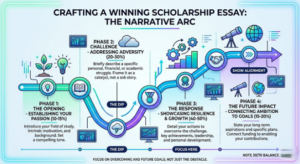
A successful scholarship essay must follow a narrative arc. It needs a clear beginning that establishes your passion, a middle that highlights how you overcame a specific challenge, and a future-focused conclusion demonstrating how the financial award will allow you to give back to society.
However, writing about personal struggles is incredibly challenging. Students often fall into the trap of writing a “sob story” that focuses entirely on the hardship rather than the recovery. Committees want to see resilience. The hardship should only occupy the first third of your essay; the remaining two-thirds must focus on your proactive responses, your achievements despite those obstacles, and your ultimate goals.
Because formatting, prompt nuances, and tone requirements vary wildly between different institutional grants, getting this balance right can feel like walking a tightrope. To avoid missing out on crucial funding opportunities due to minor stylistic errors, many applicants find it safer to connect with professional consultants at MyAssignmentHelp to buy scholarship essay packages. Studying these tailored, expert-written models allows students to see exactly how successful applications frame personal adversity without losing their professional, academic edge.
Part 3: Overcoming the Common Pitfalls of High-Stakes Writing
Whether you are writing a final capstone project or an application for a competitive international fellowship, certain structural traps can weaken your writing and dilute your impact.
1. The Thesis Drift
A thesis statement is a contract with your reader. In an academic paper, it tells the reader exactly what you will prove. In a funding essay, it outlines your core identity and ambition. A common mistake is introducing new concepts in the middle of your paper that were never promised in your introduction. Constantly look back at your thesis statement after writing each section and ask: Does this paragraph directly fulfill the promise I made at the start?
2. Rhetorical Fallacies and Hyperbole
In academic spaces, sweeping generalizations like “Throughout history, humans have always struggled with…” or “This proves without a doubt that…” will instantly damage your credibility. Use cautious, nuanced language. Instead of stating something is an absolute fact, use phrases like “The data strongly suggests” or “This evidence indicates a significant correlation.”
In funding essays, hyperbole looks like making empty promises: “If I receive this grant, I will single-handedly solve climate change.” Instead, ground your ambition in realistic, actionable steps: “This funding will allow me to complete my laboratory research in biochemistry, bringing us closer to scalable bio-fuel alternatives.”
3. Ignoring the Rubric or Prompt
It sounds simple, but thousands of well-written essays are rejected every year simply because the author ignored a specific guideline. If a scholarship prompt asks you to describe a time you demonstrated leadership, do not spend the entire essay talking about your academic achievements. Address the prompt directly, using its core keywords in your opening sentences to show the reviewer that you are listening.
Strategic Time Management for Heavy Workloads
The ultimate barrier to flawless essay writing is rarely a lack of intelligence; it is a lack of time. When deadlines converge at the end of a semester, editing is usually the first stage to be sacrificed. Yet, editing is where raw drafts are transformed into polished, high-scoring prose.
To manage high-stakes writing effectively, divide your timeline into three strict phases: Research and Outlining (40%), Drafting (30%), and Refining and Polishing (30%). Never attempt to write and edit at the exact same time. Writing requires a creative, flowing mindset, while editing requires a critical, ruthless eye. By separating these processes, you reduce cognitive fatigue and significantly elevate the final quality of your work.
Frequently Asked Questions (FAQ)
Q.1 How long should a typical university thesis statement be?
Ans: A thesis statement should ideally be one to two sentences long. It is traditionally placed at the very end of your introductory paragraph, serving as a concise summary of the main point or claim your essay will defend.
Q.2 Is it acceptable to use the first-person perspective (“I”) in a university research paper?
Ans: In most traditional STEM and social science disciplines, the third-person objective voice is preferred to maintain clinical distance. However, some humanities and reflective modules explicitly encourage first-person analysis. Always check your specific department’s style guide.
Q.3 What is the biggest mistake students make when applying for scholarships?
Ans: The most common mistake is submitting a generic essay to multiple funding bodies. Scholarship committees can easily spot a reused essay. Every application must be uniquely tailored to reflect the specific values, history, and goals of the awarding organization.
Q.4 How can I make my academic arguments sound more authoritative?
Ans: Authority comes from deep research and strong synthesis. Instead of relying on a single source to back up a major claim, reference multiple scholars who have reached similar conclusions. This demonstrates that your argument is supported by a broad consensus within the academic community.
About The Author
My name is Jack Williams, and I am a senior academic consultant and digital content strategist at MyAssignmentHelp. With over a decade of experience coaching undergraduate and postgraduate students, I specialize in breaking down complex research methodologies, advanced academic writing frameworks, and high-stakes scholarship narrative structures