Geometry Learn v3: The Powerful Tool You Never Knew You Needed
Introduction
If geometry has ever made your head spin — angles that do not add up, theorems that seem impossible to remember, and proofs that feel like a foreign language — you are not alone. Most students hit a wall with geometry at some point. The good news is that Geometry Learn v3 is here to change that experience completely.
Geometry Learn v3 is the latest version of a learning platform built specifically to make geometry visual, interactive, and actually enjoyable. Whether you are a student trying to pass your next exam, a teacher looking for better classroom tools, or an adult brushing up on old skills, this version brings something new to the table.
In this article, you will get a full breakdown of what Geometry Learn v3 offers, how it differs from older versions, which features stand out, and how you can use it to get real results. We will also cover common questions people have before they dive in. Let us get started.
What Is Geometry Learn v3?
Geometry Learn v3 is an updated educational platform focused entirely on geometry learning. It combines dynamic visual tools, step-by-step problem solving, and adaptive exercises to help users understand geometric concepts at a deeper level.
The “v3” part matters here. This is not just a minor update with a few bug fixes. Version 3 brings a redesigned interface, smarter practice algorithms, and expanded content coverage compared to earlier versions. Users who tried v1 or v2 often noticed limitations in how feedback was delivered or how topics were sequenced. Version 3 addresses those gaps directly.
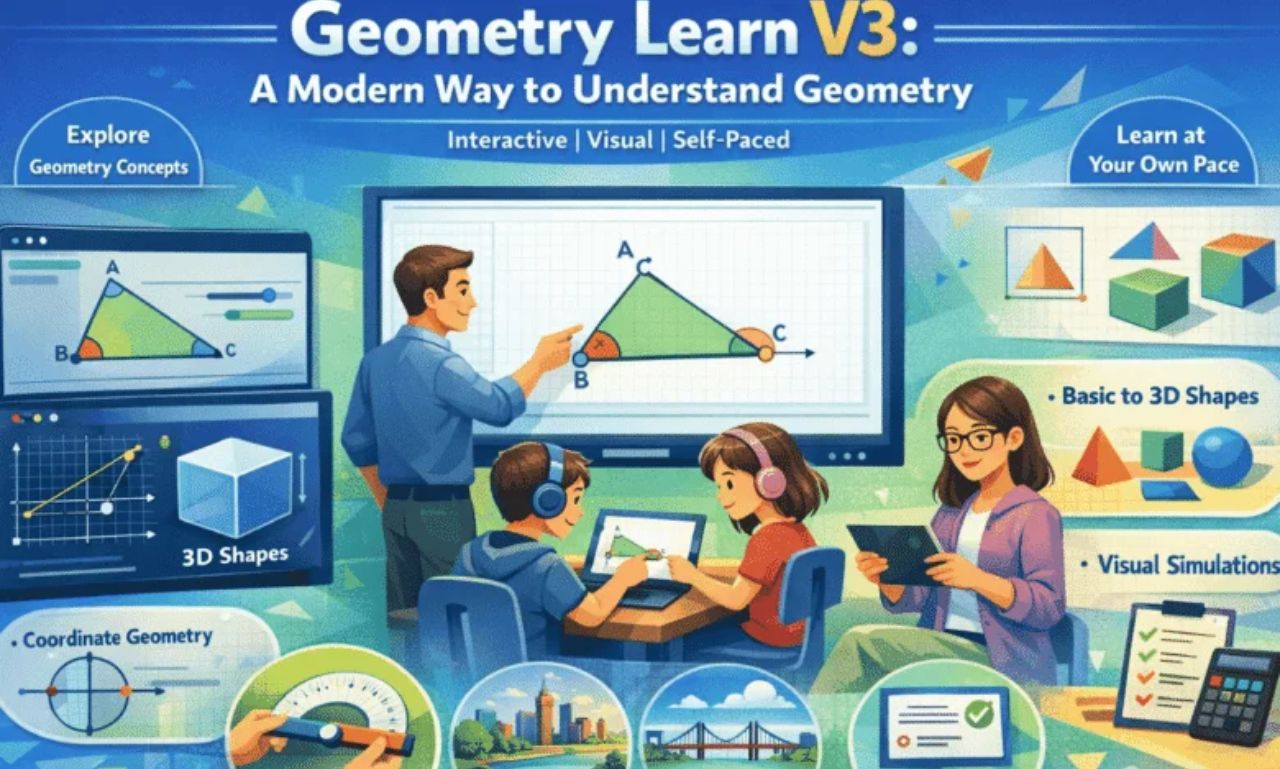
The platform covers everything from basic shapes and angles to more advanced topics like coordinate geometry, circle theorems, and geometric proofs. It works across devices, meaning you can practice on a laptop during a study session or review concepts on your phone between classes.
Key Features of Geometry Learn v3
Interactive Visual Workspace
One of the biggest upgrades in Geometry Learn v3 is the interactive workspace. Instead of reading static diagrams in a textbook, you get to manipulate shapes directly. You can drag vertices, adjust angles, and watch how measurements change in real time.
This matters because geometry is a visual subject. Reading about how an exterior angle of a triangle equals the sum of the two non-adjacent interior angles is one thing. Watching it happen as you move a point on a dynamic diagram is something else entirely. The visual workspace makes abstract rules feel concrete and memorable.
Adaptive Practice System
The platform tracks what you know and where you struggle. Based on your performance, it adjusts the difficulty and focus of your next set of exercises. If you breeze through angle calculations but keep making errors on circle theorems, Geometry Learn v3 shifts more practice time toward your weak spots.
This is a smarter way to study. Instead of spending equal time on everything, you focus on what actually needs work. Research in educational psychology consistently shows that targeted practice with immediate feedback leads to faster skill gains than passive reading or random review.
Step-by-Step Solution Walkthroughs
When you get a problem wrong, Geometry Learn v3 does not just show you the correct answer. It walks you through the full solution, step by step, explaining the reasoning behind each move. You can also request hints before submitting an answer, so you are guided rather than just corrected.
This approach supports genuine understanding. You are not just memorizing the right answer for one question. You are building the reasoning skills to tackle similar problems on your own.
Comprehensive Topic Coverage
Geometry Learn v3 covers a wide range of topics. Here is a quick overview of what you will find inside the platform:
- Basic geometry: points, lines, planes, angles, and polygons
- Triangle properties: types, congruence, similarity, and the Pythagorean theorem
- Quadrilaterals and other polygons: properties and area formulas
- Circles: radius, diameter, arc length, sector area, and circle theorems
- Coordinate geometry: distance formula, midpoint, and graphing shapes on axes
- Transformations: reflections, rotations, translations, and dilations
- Volume and surface area: for 3D shapes like prisms, pyramids, cones, and spheres
- Geometric proofs: both two-column and paragraph proof styles
That is a lot of ground covered in one platform, and it is sequenced logically so you build foundational knowledge before tackling harder material.
Progress Tracking and Reports
You can see exactly how you are doing at any time. The platform shows your accuracy rates by topic, how much time you have spent, which areas need review, and how your skills have grown over time. These reports are useful for students managing their own study plans and equally helpful for teachers monitoring a class.
How Geometry Learn v3 Compares to Earlier Versions
If you used a previous version of Geometry Learn, you might be wondering whether it is worth switching. The short answer is yes, and here is why.
Version 1 was a solid starting point. It offered clean explanations and basic interactive diagrams. But the content library was limited, and the practice system did not adapt based on user performance. You essentially worked through a fixed set of exercises in a fixed order.
Version 2 added more topics and improved the visual tools. However, users reported that the interface felt cluttered, the feedback on wrong answers was too brief, and progress tracking was not detailed enough to be genuinely useful.
Version 3 rebuilds from those lessons. The interface is cleaner. The adaptive system is more accurate. The solution walkthroughs are more thorough. The progress reports give you actual insight instead of just a percentage score. If you have tried earlier versions and were not fully satisfied, v3 addresses most of the common complaints directly.
Who Should Use Geometry Learn v3?
Middle and High School Students
This is the primary audience the platform is built for. If you are studying geometry as part of your school curriculum, Geometry Learn v3 aligns closely with standard topics covered in grades 7 through 10. The adaptive practice means it works whether you are just keeping up with class or pushing ahead for enrichment.
Students Preparing for Standardized Tests
Tests like the SAT, ACT, and various state-level assessments include a significant amount of geometry. The coordinate geometry section alone is worth spending time on. Geometry Learn v3 gives you focused, testlike practice without the noise of a general math platform that covers fifty other topics at the same time.
Teachers and Tutors
You can use the platform to assign targeted practice to students based on their current level. The progress reports make it easy to spot who needs extra help and on which specific topics. Some tutors use it alongside their sessions as a way for students to reinforce what they covered in person.
Adult Learners
Maybe you finished school years ago and now need geometry for a career change, a professional exam, or just personal interest. The platform’s pacing is self-directed, which means you are not rushed. You can move through topics at whatever speed works for you.
Tips for Getting the Most Out of Geometry Learn v3
Getting access to a good platform is only half the job. How you use it matters just as much. Here are some practical tips I would share with any student starting out.
Start with the diagnostic assessment. If Geometry Learn v3 offers an initial placement quiz, take it seriously. Do not rush through it just to get to the content faster. An accurate baseline helps the adaptive system give you the right material from day one.
Use the interactive workspace actively. Do not just watch the diagrams. Click on them, drag the points, change the values, and explore what happens. This kind of hands-on engagement builds stronger mental models than passive reading.
Review the walkthroughs even when you get an answer right. Sometimes you arrive at the correct answer using slightly flawed reasoning. Reading the official walkthrough confirms whether your approach was sound or whether you got lucky.
Set a consistent practice schedule. Research on spaced repetition shows that shorter, regular practice sessions are more effective than long, infrequent cramming. Even 20 to 30 minutes a day produces better results over time than a three-hour session once a week.
Use the progress reports to plan your study sessions. Do not just glance at your overall score. Look at the topic-by-topic breakdown and spend more time where your accuracy is lowest.
Common Challenges in Geometry and How v3 Helps
Visualizing 3D Shapes
Many students struggle to mentally picture three-dimensional shapes when they only see flat drawings of them. This is especially true when calculating volume or surface area. Geometry Learn v3 uses interactive 3D models that you can rotate and examine from different angles. This makes it significantly easier to understand what you are calculating and why the formula works.
Writing Geometric Proofs
Proofs are often the most intimidating part of a geometry course. The idea of justifying every single step with a theorem or definition feels overwhelming at first. The platform breaks proofs down into manageable steps and teaches you to think through the logical chain before writing anything down. Over time, what felt impossible starts to feel like a puzzle you know how to solve.
Remembering Formulas
There are a lot of formulas in geometry. Area, perimeter, volume, arc length, sector area, the list goes on. Geometry Learn v3 does not ask you to just memorize them. Instead, it shows you where each formula comes from and why it makes sense geometrically. Understanding the logic behind a formula is far more reliable than rote memorization, especially under test pressure.
What Makes Geometry Learn v3 Worth Your Time
There is no shortage of math learning tools available today. Apps, YouTube channels, tutoring platforms, and textbook supplements all compete for your attention. So what makes Geometry Learn v3 worth choosing?
The answer comes down to focus and feedback. Most general math platforms spread their attention across arithmetic, algebra, statistics, and calculus, with geometry getting a small slice. Geometry Learn v3 puts all its energy into one subject. The content is deeper, the interactivity is more sophisticated, and the feedback is more useful than what you typically get from a generalist platform.
The adaptive system also means that your time inside the platform is not wasted on material you already know. Every session targets your actual gaps. That efficiency adds up significantly over weeks and months of study.
Conclusion
Geometry does not have to be a subject you just survive. With the right tools, it becomes something you can genuinely understand and even enjoy. Geometry Learn v3 brings together visual learning, smart practice, and detailed feedback in a way that makes real progress possible for all kinds of learners.
Whether you are a student aiming for a better grade, a teacher looking for stronger classroom support, or someone returning to math after years away, this platform gives you what you need to build lasting geometry skills.
The best time to start is now. Try a session, explore the interactive workspace, and see how quickly things start to click. And if you have already used Geometry Learn v3, share your experience below — what helped you the most?
Frequently Asked Questions
1. What is Geometry Learn v3? Geometry Learn v3 is the latest version of an interactive geometry learning platform. It offers adaptive practice, visual tools, step-by-step solution walkthroughs, and detailed progress tracking for students and educators.
2. How is Geometry Learn v3 different from v1 and v2? Version 3 improves on earlier versions with a cleaner interface, a smarter adaptive practice algorithm, more thorough solution explanations, and significantly better progress reporting. Most limitations users reported in v1 and v2 have been addressed in this update.
3. Is Geometry Learn v3 suitable for beginners? Yes. The platform starts from foundational concepts like basic angles and shapes and builds progressively toward more advanced topics. The adaptive system ensures that beginners are not overwhelmed and that advanced users are not bored.
4. Can teachers use Geometry Learn v3 for their classes? Absolutely. Teachers can assign practice sets, monitor individual student progress, and use the detailed reports to identify who needs extra support and on which topics.
5. Does Geometry Learn v3 cover geometry for standardized tests like the SAT or ACT? Yes. The platform covers coordinate geometry, area and volume problems, and other topics that commonly appear on standardized tests. It is a useful supplement to dedicated test prep resources.
6. How much time should I spend on Geometry Learn v3 each day? Even 20 to 30 minutes of focused daily practice produces strong results over time. Consistency matters more than session length. Short, regular sessions with full attention are more effective than long, infrequent ones.
7. Is the platform available on mobile devices? Geometry Learn v3 is designed to work across devices. You can access it from a laptop, tablet, or smartphone, which makes it easy to fit practice into your schedule wherever you are.
8. What if I get a problem wrong? Does the platform just show the answer? No. When you get something wrong, the platform shows you a full step-by-step walkthrough explaining each part of the solution. You also have access to hints before submitting, so you are guided through the reasoning process rather than just corrected after the fact.
9. Does Geometry Learn v3 cover geometric proofs? Yes. Proofs are one of the more challenging parts of geometry, and the platform addresses them directly. It teaches both two-column and paragraph proof styles and walks you through the logical reasoning involved in each type.
10. Is Geometry Learn v3 free to use? Pricing details vary and may include both free and premium tiers. Check the official Geometry Learn website for the most current information on plans and access options.

Related Posts

Stay Always Updated with TXEPC Site: Your Ultimate Guide to Never Missing a Beat

Transform Your Digital Diet: The Brutal Truth About Latest Feedbuzzard Com and Why It’s the Only News Platform You Need